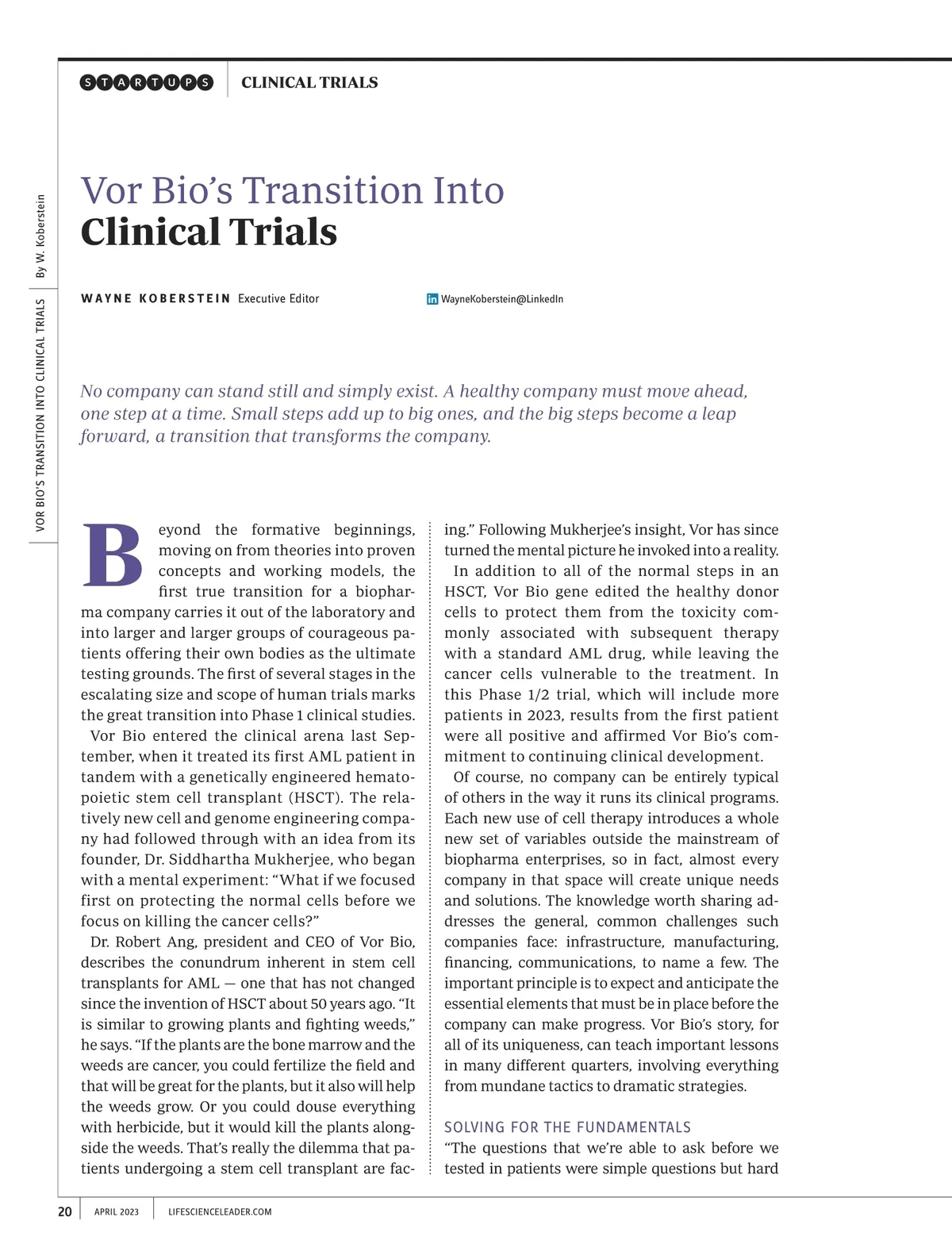
In cell therapy, there’s nothing like owning and controlling your own process, and that’s only possible if you have it in-house, and that’s exactly why we built the facility. DR. ROBERT ANG President and CEO, Vor Bio to answer,” says Ang. “One of them is this: Are we sure that we can modify stem cells and ensure they are not harmed by what we’re doing? Are they truly protected from anti-cancer therapies? We can put our gene-edited human cells in a mouse or a mon-key and compare them to cells that have not been modified and they look very similar. But a mouse bone marrow or monkey bone marrow is very dif-ferent from a human bone marrow. Similarly, the protein that we are editing is called CD33, and we know that monkey CD33 or mouse CD33 is different from human CD33. So, you can’t really answer that definitive question until you treat humans.” The question in this case drove the first human trial design. A single patient would yield a reli-able answer, without risk to additional ones. The patient’s healthy bone marrow and AML had nor-mal expression of CD33. After Vor Bio’s gene ed-iting of the donor cells, however, the post-trans-plant marrow had minimal CD33 expression and was therefore unharmed by the subsequent an-ti-cancer treatment. The company thus crossed the threshold on its way to proving it has de-vised a much safer approach to post-HSCT can-cer treatment. The Phase 1/2 trial uses the ADC Mylotarg as the anti-CD33 treatment; a second program will start up this year to test the use of a CAR-T being developed for that same purpose. Human trials also require other types of human beings — professionals in trials management, regu-latory affairs, data handling, support services, and so on. Ang has overseen an expansion of the com-pany from about six scientists when he first joined to about 24 times that number now. “That’s the kind of radical transformation you need to pivot a company from research into the clinic,” he says. “Obviously, we’ve built a lot on the science side, so we’re doing even more research than we’ve ever done before, but at the same time, there’s all this infrastructure you need to put in place to get a therapy into the clinic. There’s also the infra-structure you need around manufacturing and process development to work with these cells.” Vor Bio has built a small GMP production facil-ity in-house so it can make clinical grade mate-rial. “That puts us in a whole new realm as well because now we are making GMP products, not relying on a CDMO to do it for us. It all requires a whole range of infrastructure, and it’s a big-scale operation. It is also capital-intensive, and we’re just grateful that we have supportive in-vestors behind us to really make this possible.” Although many companies with cutting-edge technology have elected some form of in-house production, it is still useful to ask why. Was there a particular reason that Vor Bio brought the manufacturing in-house rather than rely on a full-service supplier? “In cell therapy, there’s nothing like owning and con-trolling your own process, and that’s only pos-sible if you have it in-house, and that’s exactly why we built the facility,” Ang says. “In the end, it will give us intimate control of the process, and it will serve us through late-stage development to even early commercial-ization. Most cell therapy companies are work-ing on CAR-Ts, but working with hematopoietic stem cells is so different. These cells need to be handled very differently. The processes that we’re putting these cells through is entirely dif-ferent, and even more of a stark difference for us given the cell types we’re working with.” The company’s pipeline looks relatively com-plex in how it incorporates its own products combined with products from the outside, such as Pfizer’s Mylotarg. That seems to be a broad hint that it sees complementary poten-tial in what it is developing. “We are inherent-ly enabling therapies that otherwise couldn’t be used for these patients,” Ang confirms. One step follows another, and Vor Bio appears to be in step with what it aims to do — now, and much further down the line as it follows the logical pathway to commercialization. One step at a time also implies an intense concentration on planning the way that leads ahead. L LIFESCIENCELEADER.COM APRIL 2023 21
Life Science Leader April 2023: Page 21